The Root of Microsoft and OpenAI’s Conflict: AGI
Microsoft and OpenAI, once close allies, are now in a fierce dispute over the definition of Artificial General Intelligence (AGI) and related contract terms. When OpenAI CEO Sam Altman claimed that they had mastered the method to build AGI, Microsoft CEO Satya Nadella dismissed this as “absurd metric manipulation.” This battle over the definition of AI’s ultimate form is driving a wedge in one of the tech industry’s most influential partnerships.
According to a recent in-depth investigation by The Information, a $10 billion cooperation agreement signed between OpenAI and Microsoft in 2023 has triggered significant disagreements regarding AGI terms. Microsoft is demanding the removal of a key clause that allows OpenAI to terminate technology licensing upon achieving AGI, but as of May 2025, negotiations remain deadlocked, potentially jeopardizing OpenAI’s largest IPO in history.
The core of the contract dispute lies in the “termination of technology licensing clause.” According to the original agreement from 2019, OpenAI’s nonprofit board can determine: When AI evolves to surpass human-level AGI, OpenAI has the right to immediately cut off Microsoft’s access to technology. “Everyone is laughing at this idea,” recalled an insider involved in the negotiations. At that time, Microsoft executives viewed this sci-fi-like scenario as merely the naive fantasies of technological utopians.
However, the rapid advancement of AI has dramatically changed the situation in just a few years. Altman has claimed on multiple occasions that AGI is “within reach,” and in January 2024, he publicly stated: “We have now mastered the method to build AGI,” defining AGI as a system capable of solving human-level complex problems across multiple domains. But Nadella countered on the Dwarkesh Patel podcast: “A 10% annual growth in the world economy is the real benchmark,” with Microsoft executives privately assessing that achieving AGI before the contract expires in 2030 is unlikely.
Over the past three years, Microsoft has launched a series of new software tools, such as Copilot, utilizing AI technology developed by OpenAI. Without the constraints of the “termination of technology licensing clause,” Microsoft can use this technology until 2030, based on the funding support terms provided to OpenAI.
Seeking Solutions: Shifting Focus to Artificial Superintelligence
For Microsoft, gaining access to OpenAI’s latest technology is crucial in competing with tech giants like Google. According to two participants in the discussions, as OpenAI’s technological improvements and business successes have become more apparent over the past two years, sometimes even at Microsoft’s expense, the company’s concerns about maintaining access have intensified.
Reports suggest there may be a potential solution to break the deadlock. According to an insider close to the negotiations, the two companies are considering possibly replacing the AGI benchmark with another technology, commonly referred to as artificial superintelligence, which has greater profit potential and world-changing capabilities. This would push the goal further into the future while still ensuring that Microsoft would ultimately lose access to OpenAI’s cutting-edge technology.
At the same time, according to an insider involved in the transaction negotiations, Microsoft has rejected a series of concessions related to restructuring proposed by OpenAI, including relinquishing the right to receive 20% of OpenAI’s revenue or allowing customers to access OpenAI models through competing cloud service providers. OpenAI hopes to exempt high-end products (such as the $20,000 monthly PhD-level AI) from revenue sharing. Financial calculations suggest that if OpenAI achieves its revenue target of $17.4 billion by 2030, the revenue-sharing amount would exceed Microsoft’s entire annual cloud computing profits.
Despite these points of contention, according to one person who has spoken with Nadella, executives from both companies continue to meet daily to discuss their contract, and Nadella and other Microsoft executives still believe they can reach an agreement without a complete breakdown.
According to internal forecast documents, OpenAI needs to burn through $46 billion over the next four years to maintain R&D, making IPO financing a necessity for survival. The deadlock is affecting the investment nerves of Silicon Valley. “If the restructuring fails, the special equity structure will turn the IPO into a bubble,” admitted a top venture capital partner holding OpenAI shares.
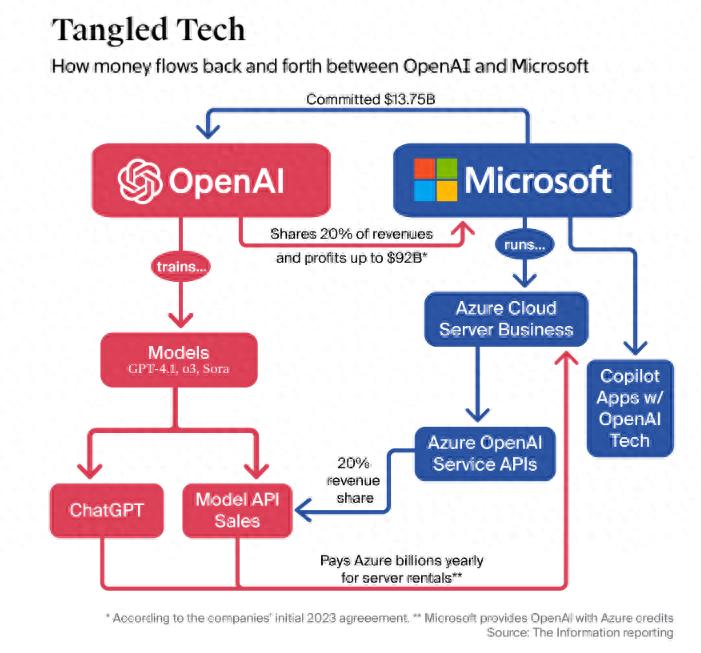
Alliance Fractures Accelerate
Looking back at the cooperation honeymoon period in 2019, Microsoft provided a lifeline of computing power to OpenAI, which in turn helped Microsoft create flagship products like GitHub Copilot using GPT technology. However, the unexpected popularity of ChatGPT at the end of 2022 completely altered the balance of power.
Now, the fractures in the alliance between Microsoft and OpenAI are rapidly manifesting in the commercial battlefield, with reports indicating that the collaboration rift has spread to operational levels:
• Computing Power Competition: In 2024, OpenAI switched to Google Cloud due to insufficient computing power from Microsoft and reached a cooperation agreement with Oracle;
• IP Disputes: Microsoft AI head Suleyman has repeatedly protested OpenAI’s concealment of key technical details (such as the “chain of thought” reasoning mechanism);
• Alternative Solutions: Microsoft is accelerating the development of its own Phi model and recruiting the Inflection team to create backup solutions.
Comments
Discussion is powered by Giscus (GitHub Discussions). Add
repo,repoID,category, andcategoryIDunder[params.comments.giscus]inhugo.tomlusing the values from the Giscus setup tool.